“Artemis II will launch without crew, and Artemis IV will be the crewed lunar landing”
This should be the headline, one day soon, in a world where these decisions are primarily technical and think long term. Let's get into it.

This should be the headline, one day soon, in a world where these decisions are primarily technical and think long term. At no extra cost, while we wait for lunar landers, Artemis II uncrewed and Artemis III as the first flight of SLS/Orion with crew, would close out all non-lander risk. Artemis IV, with the EUS, would be the first crewed mission and lunar landing, and where performance really opens up anyway.
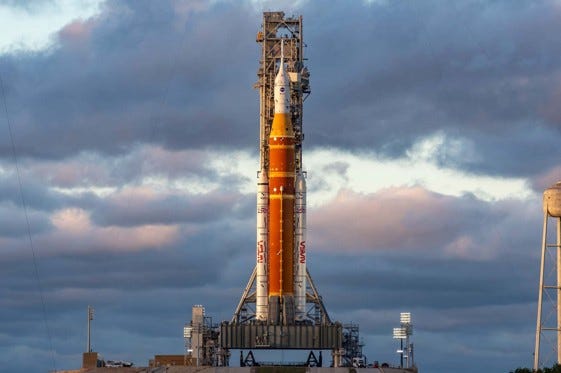
I’ve written before about reasons not to put crew on Artemis II, the next SLS/Orion flight, currently scheduled for no later than April 2026. (Yes, you read that right, “no later than”, not “no earlier than”.) There are plenty of moving parts NASA has to contend with in its lunar “architecture”, Artemis, that assemblage of rockets, spacecraft, landers, and other parts and pieces for any human spaceflight mission.
This is landers plural, with a SpaceX Starship in the works, the one getting most of the press, but also a Blue Origin Blue Moon lander. This is one horse race, between landers, inside the more often emphasized race, the one to get to the Moon first, before China.
There are other elements often forgotten, the SLS upper stages. Stages, also plural. The Artemis II and III flights will use the last two of the discontinued Interim Cryogenic Propulsion Stages (ICPS), leaving NASA to await its new Exploration Upper Stage (EUS) for subsequent flights. For Artemis IV and beyond, NASA must complete development of this new upper stage and ensure it’s flightworthy.
But in complex plans, delays in one part will cascade, leading to unexpected outcomes. The unplanned outcome becomes a trap, and the stress of falling into it can lead to poor decision-making. This is NASA’s current situation, if honestly assessed, with no adornment.
Who would have made the plans that got NASA where it is? No sane person, of course. (I am using the word “plans” liberally here, as would NASA leadership.) Because, quite simply, anyone wanting to increase their probability of success in a complicated system would have added insurance here and there. You would have ordered up an extra ICPS, or two. You would have added additional urgency to the development of the EUS, the stage you really want but have to do from scratch. You would have backup plans. (The list can go on.)
Yes, all this is woulda, coulda, shoulda.
A supervisor of mine at NASA once said, in response to my position on the need for such “margin” in a project, that this was simply not how NASA worked. Let me explain. “We work to a plan, not to what might happen,” he said. The words still ring in my ears. Of course, that project went south, wholly expected on my part. Ho-hum. Moving on. Except to hear everyone’s sighs of surprise. That I found odd.
The same syndrome about lack of margin might be said of a lunar exploration program that did not award a lunar lander contract to SpaceX until 2021. The investment before that was relatively meager. A second lunar lander contract with Blue Origin came only two years ago. Woulda, coulda, shoulda.
Also in the blender is the Orion heat shield, which performed poorly during the Artemis I uncrewed mission. I will repeat what I said before, “The intent of the Artemis I uncrewed mission, which involves a sound understanding of the design as it will be when carrying a crew, combined with a successful flight experience, has not been met. Artemis II should launch without crew, placing the currently assigned crew onto Artemis III, assuming a successful Artemis II.”
The lack of transparency about Orion’s heat shield problems should sound more alarm bells.
And yet, there is a way to square this circle, very well at that. This is based on an uncontroversial point:
The unlikely readiness of a Starship lunar lander for Artemis III, currently scheduled for 2027.
The benefit is:
Retiring all non-lander risks before a crew goes to rendezvous with any lander in lunar orbit.
The NASA plan, as it stands, is:
Artemis II: SLS/ICPS and Orion with crew do a lunar fly-by
Artemis III: SLS/ICPS and Orion with crew meet up in lunar orbit with Starship, and the crew lands on the Moon
This assumes the Starship is ready (highly unlikely)
Artemis IV: SLS/EUS and Orion with crew (and some Gateway hardware) and Starship again, with another Moon walk
The new NASA plan would be:
Artemis II: SLS/ICPS and Orion with NO crew does a lunar fly-by
Artemis III: SLS/ICPS and Orion with crew does a lunar fly-by, assuming Artemis II goes as expected
All non-lander risks are retired
The Starship is NOT ready after all
Artemis IV: SLS/EUS and Orion with crew, and Starship (if ready), do a Moon landing
A first retort might be to scream, “But costs!” The costs of delay in getting crew aboard SLS and Orion for Artemis II are extra. The (flawed) logic would go along the lines that all delays are a cost. None of this is true, once you know how money sloshes around in NASA Human Spaceflight.
Let me explain. (Takes out red pill.)
I never lost a bet saying a NASA project would be delayed, a lot more than the official plan would admit, or that the project leadership wanted to hear. My numbers and charts rarely won any hearts and minds. So, here is a story version instead.
Seemingly decades ago, NASA teams debated adding a solid rocket segment to the existing four-segment solid rocket boosters, thereby increasing fuel and, in turn, boosting performance. Simple enough. I was there in this debate. To understand how real money flows at NASA, it’s crucial to realize that the decision to use solid rockets in the next system after the Shuttle was a done deal. Also, it was clear at the time that no new system using solid rockets was coming along in a year, or three, or five. (The actual number became decades.) NASA was going nowhere soon with a larger rocket and any boosters, of the Shuttle kind or the longer kind. It’s all about the context here. So, I often pointed out the simple reason to go with five-segment boosters: the upgrade would be free.
Yes, free.
Behold the math of cost-plus, and keeping burners warm.
NASA was going to make sure the manufacturer stuck around after all, not stuck around like a guard at the plant with a few dogs behind a fence until they open again, hire new people, and bring the machinery of production back online. More like most everyone is staying, and most of the money would keep flowing, Shuttle or not, launches of a new rocket or not. The money was still going to end up in Utah, year after year. Period. (The same logic goes most of the way to explaining the cost of SLS engines.)
If anyone were ever to compare doing nothing vs. adding the additional solid rocket segment, after many years not launching, you might find some money in a third decimal. When your bar charts are in the billions, what’s a smidgen lower bar? You would have to squint at the chart to notice. You might as well keep the contractor doing something, like adding a fifth segment to the solid rockets. e.g., adding the fifth segment is free.
To this day, not everyone agrees with this view or the math. It would be easy to find someone at NASA right now who argues that Orion has not, in fact, cost $24 billion to date. They would say that most of that money was to maintain human spaceflight capabilities, people, and facilities (raising voice). It was also for Lockheed, which got $15 billion of that, most of which was to keep people around, and it was not really spent on Orion (rolls eyes as if obvious). You get the idea.
In fact, it was Orion. It was always Orion. Magical accounting will never make the contrary case, and if anything, will reveal in the light of day the way dollars really flow. Context is crucial, and will reveal a remanifest of Artemis II to a flight without crew, and Artemis III with crew, will have a negligible effect on budget requirements or cost.
Other retorts besides costs, like flight rate, production rate, SLS cores, and so on, won’t hold up much better.
Which brings up the obvious. How does a crew end up on the second SLS/Orion flight after the first did not perform well in the heat shield and did not test a full-up life-support system, among other issues? I would not be the only one, or the first, to note this disconnect between the understanding of the SLS/Orion and when to place a crew aboard.
It is no stretch to say the decision to place crew aboard SLS/Orion on the next launch, Artemis II, is bowing to political expectations, not because of technical readiness. A cynic would add that, after SLS/Orion has flown crew, SLS/Orion will likely store away the Artemis III hardware anyway, as the finger-pointing about delays in a Moon landing shifts to SpaceX Starship. This is even less of a reason to put crew aboard Artemis II, but too many projects at NASA have taught me that the oddest motivations do arise.
There is little to gain from a decision to put crew on this next SLS/Orion, but possibly everything to lose. Instead, if Artemis II is uncrewed, then Artemis III, with a crew, can build on the secure foundation of Artemis I and II, retiring all non-lander risks. Any lunar lander is unlikely to be ready for Artemis III anyway, and the rush to put crew on Artemis II will all have been for nought, an unnecessary risk.
Touch decisions await the next NASA Administrator. These decisions should be driven by technical readiness, risk, context, and what’s to be gained in the long term. NASA has already lost enough lives due to dysfunctional decision-making. The price of knowing is patience. The price of haste is paid in blood.
NASA did not go with a reusable system in SLS/Orion. It is all disposable. It’s time the dysfunctional decision-making is disposed of, too.
To repeat:
The new NASA plan for SLS/Orion and the Artemis lunar program should be:
Artemis II: SLS/ICPS and Orion with NO crew does a lunar fly-by
Artemis III: SLS/ICPS and Orion with crew does a lunar fly-by, assuming Artemis II goes as expected
All non-lander risks are retired
The Starship is NOT ready after all
Artemis IV: SLS/EUS and Orion with crew, and Starship (if ready), do a Moon landing
From a longtime NASA LaRC engineer:
Good post, Edgar.
Planned flight tests of new "government-led" launchers and spacecraft are fewer and farther between these days than they were in previous human spaceflight programs, such as Apollo. I've wondered before about why this is. One possibility is that due to the improvements in analytical modeling and computational capabilities over the years since the 1970's, program managers are confident that a more streamlined flight testing campaign can be sufficient, essentially, skipping some tests. "Today we can do more for less, and quicker, than the old days," would be the claim. It can also help to sell a new program when the availability of funding is a major factor, which it has been for decades now. This is just the impression I've had. I want to say that I've actually heard these things stated before in meetings, but I may have misinterpreted or imagined that.
If this "we can do things better than we used to" line of thinking is the underlying rationale, are people really just fooling themselves?
As I've mentioned before, we often consider Apollo to be the gold standard for how to do a human spaceflight program right. On the topic of heat shield testing, in Apollo there were two tests of the CM heat shield at simulated lunar return conditions prior to any crewed flights. The first utilized a Saturn IB to launch a fully-functional Command Service Module on a suborbital trajectory. This test was designated AS-202. With the help of the service module, the reentry velocity was increased to over 19,000 mph. Not quite up to a lunar return, but still a useful demonstration.
The CM heat shield would be tested again without crew on Apollo 4 (AS-501). This was the first all-up flight test of the complete Saturn V and Apollo spacecraft system. In this case, the heat shield was tested at actual lunar reentry conditions (~25,000 mph). One thing that I just noticed when looking this up is that the heat shield was a Block II design, whereas AS-202 flew a Block I design intended for returns from Earth orbit. The results of AS-202 had been used to improve the Block II design, which was intended specifically for the lunar missions. There are similarities here with Orion heat shield development, but without the issues encountered by Artemis 1.
With the success of Apollo 4, the way was clear for crewed flights. The first of these was Apollo 7, which spent 10 days in LEO. Apollo 8 went all the way to lunar orbit and back.
I think your proposed new plan holds up pretty well. However, if we were to follow the example from Apollo, the first flight of an SLS Block 1B for Artemis IV would be without crew. In addition to the heat shield demonstration, Apollo 4 simulated the translunar injection burn. The SLS B1B w/EUS represents a new configuration compared with Block 1. There is some additional risk involved in utilizing this for the very first time to send Orion to the Moon with crew onboard.
Concerning the Starship lander development, the leaked acknowledgment that a human landing would be delayed to late 2028 should, logically, be factored in. This does open the possibility to redefine the early Artemis missions. You may recall that Jim Free, lead of ESDMD at the time, made some comments a few years ago to this effect. https://spacenews.com/nasa-weighs-changes-to-artemis-3-if-key-elements-are-delayed/
Note that Free thought at that time in mid-2023 that Artemis 2 would fly by November 2024. The heat shield issue from Artemis 1 (mostly) changed that. Everything has been slipping for a while.